







Lake Michigan Shore AVA: History & Overview
- 1868
Vineyards in Lawton
A.B. Jones plants vineyards in Lawton, attracting Welch's to the region during Prohibition and marking a pivotal milestone for the industry.
- Late 1800s
Third in Production
Michigan ranks third in wine production behind California and New York.
- 1918
Alcohol Ban
Michigan enacts a ban on alcohol, ceasing the legal wine industry.
- 1920
Prohibition
National Prohibition bans alcohol across the United States.
- 1933
Repeal of Prohibition
Michigan is the first state to ratify the repeal, allowing wineries to reopen.
- 1934
St. Julian Winery
Meconi Wine Co moves to Paw Paw, becoming St. Julian Winery, now Michigan’s oldest continuously operating winery.
- 1938
Michigan Wine Institute
Michigan Wine Institute is established to support the wine industry.
- 1940s
Wine Industry Moves West
A strong wine industry emerges in Southwest Michigan, with most wineries relocating near Lake Michigan vineyards. Consumers begin to shift towards dry wines.
- 1950
Licensing Fee Eliminated
Michigan eliminates a $5,000 licensing fee, boosting wine production by enabling sales in grocery stores.
- 1962
First Dry Wine
Bronte Champagne and Wine Co. produces Michigan’s first dry wine with Baco Noir, a French-American hybrid grape, in Hartford.
- 1981
Fennville AVA & Bob Hope
Fennville becomes an American Viticultural Area. Bob Hope orders 80 cases of Tabor Hill’s Vidal Blanc demi-sec for his 80th birthday.
- 1983
Lake Michigan Shore AVA
Lake Michigan Shore becomes an American Viticultural Area.
- 1985
Michigan Wine Council
The Michigan Grape and Wine Industry Council is established, later becoming the Michigan Craft Beverage Council.
- 1990s
Wineries Expansion
Thirteen new wineries open across Michigan.
- 2000s
New Varieties and Styles
Numerous new wineries open, exploring diverse varieties, styles, and viticulture practices.
The viticultural history of the Lake Michigan Shore region dates back to the mid-19th century, with the first grapevines planted in the 1860s. By the early 20th century, the region had established itself with a substantial amount of land under vine. However, in the 1920s, Prohibition caused many growers to pivot to grape juice production until the law's eventual repeal in 1933. Following Prohibition, there was a resurgence in winemaking activities, and the area continued to develop its reputation for quality grape production, evolving from predominantly sweet wines to a diverse region of many styles.
In 1983, the Lake Michigan Shore was designated as an American Viticultural Area (AVA), recognizing its unique climate and geographical features ideal for viticulture. This designation followed the establishment of the Fennville AVA in 1981, which is entirely contained within the Lake Michigan Shore AVA. The AVA extends from the Kalamazoo River in the north, stretching approximately 45 miles inland, down to the Michigan-Indiana state line, and then back west to Lake Michigan.
Today, the Lake Michigan Shore AVA plays a crucial role in the state's wine industry, with Michigan being the fourth largest grape-growing state in the United States. The AVA accounts for nearly 90% of the state's vineyards. The region's unique climate, influenced by the lake effect from Lake Michigan, allows for an extended growing season and the cultivation of a diverse range of grape varieties, including hybrid varieties, American grapes, and European vinifera, usually poorly suited to cold climates.
Economically, the wine industry, largely driven by the Lake Michigan Shore AVA, has a substantial impact on the state. Wine generates revenue estimated to be in the hundreds of millions annually. This economic contribution is bolstered by wine-related tourism, which attracts over 1.7 million visitors annually to Michigan wineries, resulting in $253 million in tourism expenditures. This influx of tourists boosts the local economy and supports related sectors such as hospitality, retail, and food services. As of 2017, the industry provided 47,299 jobs, pays $1.8 billion in annual wages, and contributes $853.6 million in annual taxes. The total economic impact of the wine industry in Michigan is $5.4 billion, with wineries producing 2.75 million gallons of wine annually. Additionally, the industry contributes $13.5 million in charitable donations.
Lake Michigan Shore is traditionally a fruit-production area, with a significant portion of the grape vines in the AVA intended for table juice and jellies rather than wine. The majority of the acreage is planted with varieties such as Concord and Niagara. However, the wine-grape output is sufficient to supply a growing number of wineries, located primarily along Lake Michigan's eastern shores. These wineries grow Chardonnay, Riesling, and Pinot Noir, and many more vinifera varieties as well as hybrids such as Chambourcin and Traminette.
The AVA covers nearly 1.3 million acres (526,000 hectares) of low, rolling hills on the southeast edge of Lake Michigan, extending inland for around 45 miles (70 kilometers). The northern boundary of the AVA is marked by the Kalamazoo River, and the southern edge runs along the state border with Indiana.
The region benefits from the lake effect, where Lake Michigan acts as a temperature moderator throughout the year, making the area suitable for viticulture despite its northerly latitude. In spring, winds from the chilled lake delay bud burst until after the greatest frost risks have passed, and in summer, the water warms, extending the fall growing season with warm air from the lake. In winter, at least in years past, heavy snow sometimes covers the vines and protects them against ground freezes. The growing season in Lake Michigan Shore is often several weeks longer than in Michigan's more northern AVAs, such as Leelanau Peninsula and Old Mission Peninsula.
The topography of Lake Michigan Shore, shaped by glacial movement, features sandy slopes and hills made up of glacial moraine. These provide a free-draining, deep base for the vines, allowing for strong root systems and good air drainage, which helps reduce frost damage.
Culturally, the Lake Michigan Shore AVA has become a symbol of Michigan's rich agricultural heritage and its evolving focus on quality production that rivals that of Europe, New York, and California. The AVA is home to numerous small, family-run wineries that produce a wide array of wines, demonstrating the region's versatility and quality. Events such as wine festivals and organizations like the Lake Michigan Shore Wine Trail and Michigan Craft Beverage Council further promote the region, drawing wine enthusiasts from across the country and enhancing the area's reputation as a premier wine destination.
Read the official Federal Register creating the AVA on October 13, 1983
Growing Conditions
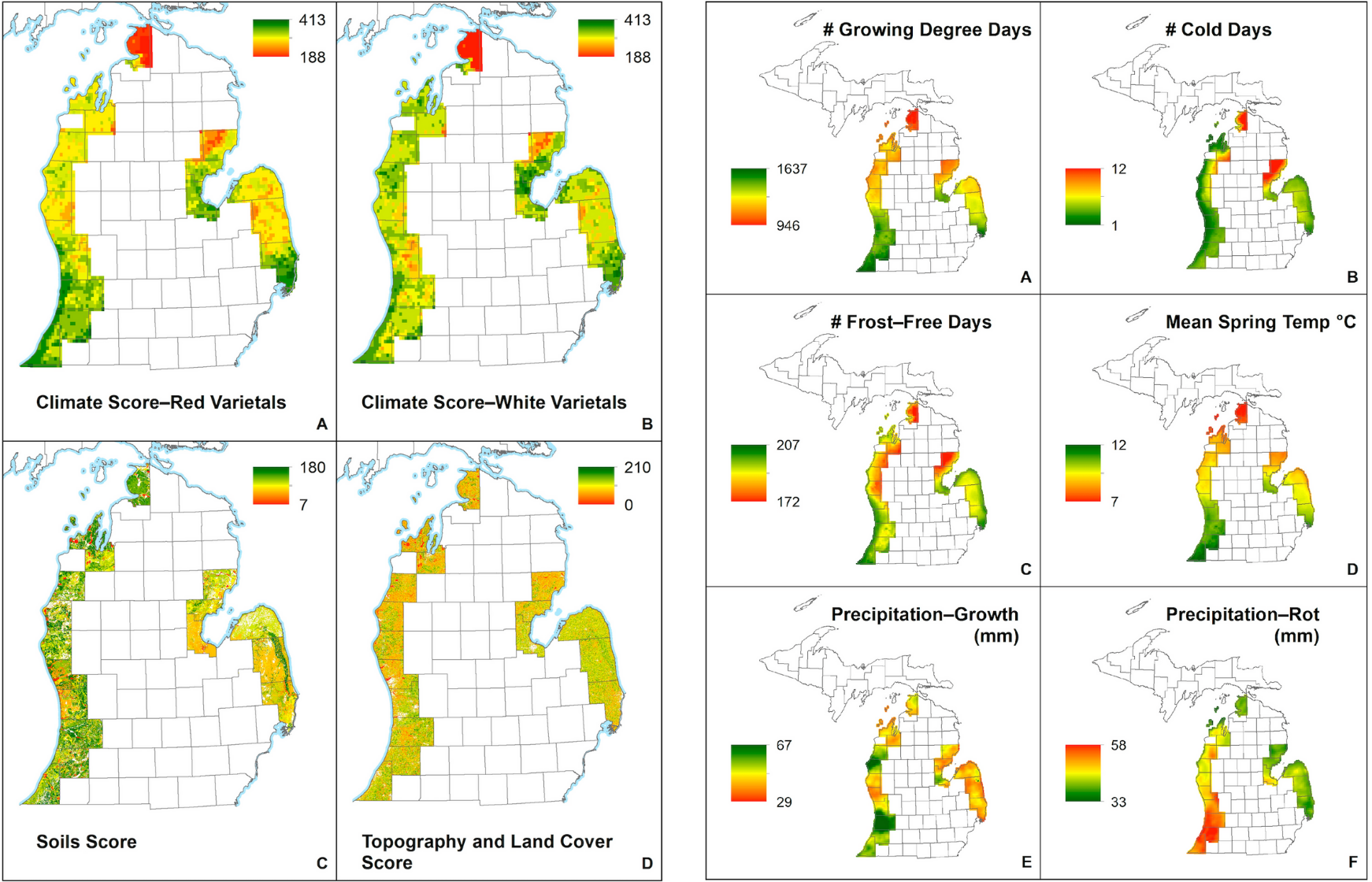
The growing conditions in the Lake Michigan Shore AVA are ideal for wine grape growing, including vinifera, due to its optimal combination of climate, soil, and topography. Studies highlight that, compared to other areas of Michigan, the region enjoys a warmer climate with extended growing seasons, which are essential for achieving the desired phenological stages of grape development. Berrien, Allegan, and Van Buren counties, in particular, exhibit some of the highest suitability scores, largely due to their favorable temperature ranges and growing degree days (GDD).
The soil profile in southwest Michigan further builds its potential for high-quality grape production. The region is characterized by well-drained often sandy soils with suitable pH levels and deep rooting zones. These attributes are critical for healthy vine growth and fruit maturation, ensuring that the vines receive adequate water drainage and nutrient availability. The soil conditions in counties such as Berrien and Allegan are especially conducive to vinifera cultivation, providing the necessary foundation for robust vine health and fruit quality.
Topographically, southwest Michigan offers significant advantages for viticulture. The low hills allow for many south-facing slopes in the region maximizing solar exposure, which is crucial for the early ripening of grapes—a key factor in cool-climate viticulture. These slopes, combined with the moderating influence of Lake Michigan, help to mitigate temperature extremes and extend the growing season. This lake effect creates a microclimate that reduces the risk of frost and enhances overall grape quality.
The convergence of favorable climate, optimal soil conditions, and advantageous topography makes southwest Michigan an ideal American region for expanding Vitis vinifera vineyards and exploring the top potential of hybrid varieties. The specific climatic and physical attributes of counties Berrien, Allegan, and Van Buren position them at the forefront of Michigan's future viticulture potential, supporting the production of high-quality wine grapes and the growth of the state's wine industry.
Wineries

Stranger Wine Company
Filkins Vineyards

Vineyard 2121
St. Julian Winery

12 Corners Vineyards
Domaine Berrien Cellars
Baroda Founders
Round Barn Winery

Lawton Ridge Winery

Lazy Ballerina Winery

Dablon Vineyards

Gravity Vineyards
Lemon Creek Winery

Red Top Winery

Hickory Creek Winery
Free Run Cellars

Tabor Hill

Golden Muse

Moonrise Winery

Warner Vineyards

Chill Hill Winery
Interesting Varieties
Must Try Bottles
Section coming soon... We've been taking lots of notes the last few years and are excited to share what we enjoyed most.